
BPS conducted its second Historic Bridgetown Photo Walk under the leadership of Dr. Frederick Alleyne on April 6th 2024.


Having completed our stop at Marhill Street and Trafalgar Square we approached Amen Alley, the narrow track between two horse racing establishments. What immediately assaulted the nostrils was the smell reminiscent of a horse stable and one would have had the impression that the horses being betted upon were actually housed in the two buildings. So, we made a swift and breathless passage through the short alley and emerged at the other end to say a grateful “amen” for the return to untainted, fresh air.
But to the black Africans during the decades of slavery, the shout of “amen”, while standing in the shadows on the same spot on which the BPS photographers were now standing, did not signal their relief from the stench of religious exclusion and denial of human dignity by the established Anglican Church. Rather, those black souls who firmly believed in their own spiritual worth and found the time and space to position themselves to faintly hear sermons emanating from behind the Cathedral walls continued their tradition of shouting “AMEN “from the safe, segregated distance of Amen Alley.
But returning to the present time, we saw the building which once housed the Harrison College School and now is an exhibition hall associated with the Barbados Museum and Historical Society. We also saw the Central Bank of Barbados building that dominates the city landscape and from its highest offices provides a scenic, bird’s eye view for miles in all directions.
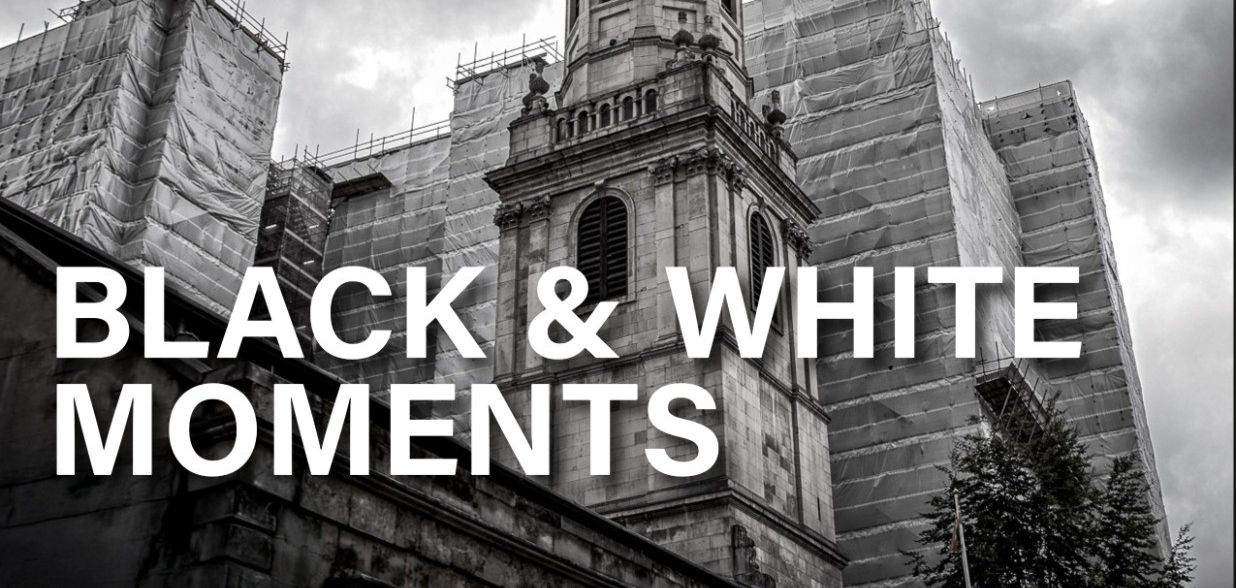
After a brief pause for some street photography and architectural shots, we proceeded to the graveyard of St. Michael and All Angels Cathedral. The first church built on the site in 1665 was destroyed by the hurricane of 1780 and the current building was constructed in 1789. It was subsequently consecrated as a Cathedral with the coming of its first Bishop in 1824.
The history of Bridgetown can be easily compiled, in part, from the tombstones of those interred under the central aisle of the church and those entombed in the graveyard. Many notables of state, the military, the church and commerce between the 17th and 19th centuries were buried in this graveyard.

By chance, we came upon the grave and headstone of Sir Thoms Gilbert Carter and his wife Gertrude, backlit by the morning sun. The carved marble gravestone revealed that Sir Gilbert served the British Crown in Africa as Treasurer of The Gold Coast, Administrator of The Gambia and Governor of Lagos during his various postings on that continent. He subsequently became Governor of the Bahamas and then Governor of Barbados in 1904.
Once the threat of a light drizzle on our exposed camera equipment had passed, we pressed on through the Village Green. This is a recreational city space that was created as part of the Central Bank development, as envisioned by Sir Courtney Blackman, the first Governor of the Bank. The area had been a cramped settlement of small chattel houses and small shops which were relocated to make way for the planned urban renewal and at the same time, to provide a better standard of housing for the former residents.

Having just seen the grave of Lady Gertrude Gilbert-Carter in the Cathedral graveyard, the final landmark of interest in this historic Bridgetown photo walk was Queens Park, where her design talents remain very much evident today. She was responsible for the design and layout of this city park which was opened in 1909 after the Government bought the expansive area from England.

Those of us who used to frequent Queens Park in our youthful days would be familiar with large pond and fountain next to the central thoroughfare and the gazebo under which The Police Service Band performs at Christmas and other festive occasions. Lady Gilbert-Carter designed these two features as well as the Clock House which faces the Queens Park Gallery.

The Queens Park Gallery building was originally the residence of the Commander of the British Forces in the Caribbean. It was reconstructed in 1784 after the original structure was destroyed by the great hurricane of 1780. BPS was privileged to have held its outstanding 20th-anniversary exhibition “Twenty Years of Light” in the gallery during January 2024.

We concluded our historic Bridgetown photo walk with Dr. Alleyne informing us about post-emancipation educational arrangements and the creation of the Central School opposite Queens Park. Originally intended by Henry Drax, plantation owner and philanthropist, to be a free school for poor white boys, the school eventually catered for both genders by 1825. Out of that arrangement, the Combermere School for boys and the Queens College School for girls later evolved. Today, however, both of these schools are co-educational and are sited well away from their city origins and as neighbours to Queens Park.
During my walk back to Heroes Square, I once again enjoyed the sight of the Village Green and the contrasting architecture of the Cathedral church and of the towering Central Bank building. Continuing on, I took great pains to avoid the urinous smell of Amen Alley and finally caught up with the lead group to thank Dr. Alleyne for a most informative photo walk through the history of a small part of Bridgetown.
Victor Gittens